Choosing between an AI CMO and a traditional marketing agency depends primarily on your current revenue stage and available time. An AI CMO provides immediate execution and strategic frameworks for founders who need to build an audience while actively writing code. A human marketing agency offers deep strategic nuance for companies with established budgets seeking to scale complex enterprise campaigns. The most effective choice aligns your marketing execution method with your current cash flow and product maturity.
Key takeaway: Solo founders with limited budgets often find more success using an AI CMO to handle daily lead generation and content distribution. Companies with proven product market fit and marketing budgets over ten thousand dollars a month are typically better suited for human marketing agencies that can manage highly nuanced brand campaigns.
What is an AI CMO and how does it operate?
An AI CMO functions as an autonomous software entity capable of planning and executing multi-channel marketing campaigns with minimal human oversight. It bridges the gap between passive scheduling software and proactive strategy execution.
AEO (Answer Engine Optimisation) is the practice of structuring content so it gets extracted and cited by AI-powered answer engines like ChatGPT, Perplexity, and Google AI Overviews, rather than just ranked in traditional search results. Unlike SEO, which targets algorithms, AEO targets the summarisation layer above them.
An AI CMO (Chief Marketing Officer) is a software system that uses artificial intelligence to plan and execute a complete marketing strategy. Unlike basic scheduling tools, an AI CMO operates as an autonomous team that can identify leads, generate content, and monitor search rankings without constant human supervision.
Most founders confuse basic automated campaigns with intelligent agents. A standard scheduling tool requires you to write the post, format the image, and pick the time. An intelligent system evaluates your website, understands your ideal customer profile, and drafts the content based on current search trends. This shift from manual input to autonomous output significantly reduces the time solo developers spend outside their code editor.
To maximize the output of autonomous software, you must clearly document your product value proposition on your public website. Intelligent agents pull their context directly from your landing pages. If your website messaging is vague, your automated outreach will be equally unclear.
AI CMO vs marketer: Evaluating cost and execution speed
The debate of an AI CMO vs marketer often comes down to balancing the immediate need for audience growth against the available financial runway. Software executes tasks instantly based on established parameters, while human marketers require time to study the market and build relationships.
Human agencies typically require a thirty to sixty day onboarding period before launching a single campaign. They use this time to build buyer personas, audit existing content, and establish reporting frameworks. For a bootstrapped solo developer, two months of zero output can stall early growth momentum.
Autonomous systems begin executing on day one. However, this speed comes with a trade-off in qualitative judgment. Software can identify a trending topic on social media instantly, but a human marketer can tell you whether engaging in that specific trend aligns with your long-term brand reputation.
| Feature | AI CMO Software | Human Marketing Agency |
|---|---|---|
| Launch Speed | Immediate | Weeks to months |
| Monthly Cost | Low | High |
| Strategy Adaptation | Data-driven | Nuance-driven |
| Empathy & Tone | Basic to moderate | Highly tailored |
| Best Stage | Pre-revenue to early growth | Scaling to enterprise |
Finding the best AI marketing automation setup
The most effective marketing systems for solo developers combine multiple specialized functions into a single cohesive workflow. Fragmented tools require too much manual integration, defeating the purpose of automation entirely.
Many solo developer tools focus exclusively on one channel, such as generating blog posts or scheduling social media updates. This forces the founder to act as the central routing hub, moving data between platforms. A better approach is to utilize a system that operates as a unified ai marketing crew, where different agents handle distinct aspects of the funnel simultaneously.
For example, Runlo provides a cohesive crew tailored for solo B2B founders. Instead of asking you to fill out endless onboarding forms, its Warden agent scans your existing website to build a strategic brief automatically. This ensures that every subsequent piece of content or lead generation effort shares the same foundational understanding of your product and target audience.
To evaluate any automation platform, test its ability to handle context. Feed the system your current landing page URL and ask it to draft an outbound message. If the resulting text sounds like a generic template, the platform lacks the semantic depth required to replace human effort.
Decision framework: Which path is right for your startup?
Choosing the right marketing approach requires an honest assessment of your current resources and goals. Use this framework to decide where to allocate your efforts.
If you are a pre-revenue solo founder building your first product, use an AI CMO. You need immediate top-of-funnel visibility and cannot afford thousands of dollars in monthly retainer fees. Focus on software that helps you distribute content and monitor basic SEO metrics while you refine the product.
If you have a small team with steady revenue but no dedicated marketing hire, combine an AI marketing crew with freelance specialists. Let the software handle repetitive lead generation and content distribution, and hire a human consultant for high-level positioning and product messaging.
If you are an established company seeking to enter a completely new market segment, hire a specialized marketing agency. Software excels at scaling known strategies, but humans are far superior at navigating the ambiguity of entirely new consumer psychology and unproven positioning statements.
READ: Cost of Marketing Agencies in 2026.
Structuring automated campaigns for lead generation
Successful lead generation requires moving beyond mass messaging and focusing on specific behavioral triggers. Automated campaigns are only effective when they target prospects actively displaying intent.
Passive lead generation relies on waiting for people to search for your solution. Active outbound lead generation requires finding people where they already discuss their problems. For B2B software, this often means monitoring specific communities like Reddit or tracking professional changes on LinkedIn.
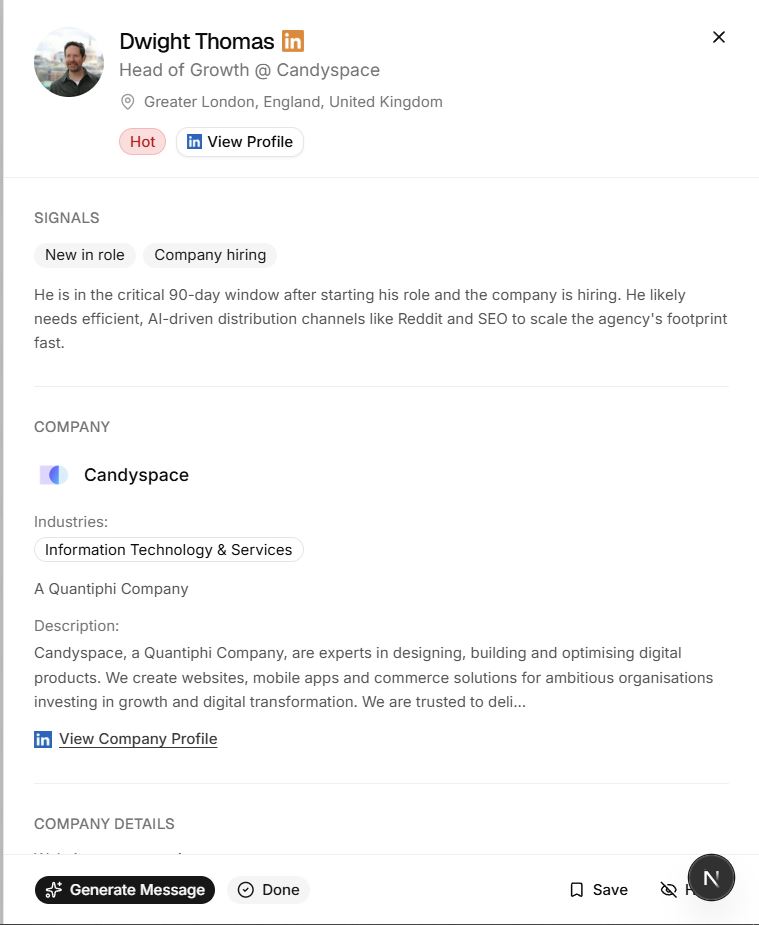
The most reliable way to improve outbound conversion rates is to tie your outreach to a recent event. Reaching out to a prospect simply because they fit a job title yields low responses. Reaching out because they recently started a new role or their company just announced a funding round provides a natural, relevant reason for the conversation.
This is where specialized tools streamline the process. The Eva agent within Runlo specifically monitors LinkedIn for over ten different intent signals, such as new executive hires or recent funding rounds. By identifying these changes automatically, founders can reach out precisely when a company has fresh budget or new leadership looking to implement modern software solutions.
Where an autonomous marketing crew falls short
While automated systems provide massive leverage for solo founders, they are not universally perfect solutions. Acknowledging these limitations ensures you do not delegate tasks that require a human touch.
An AI CMO struggles significantly with crisis communication and sudden shifts in cultural context. If an industry-wide event requires a delicate, empathetic response, software will likely default to generic corporate phrasing. Furthermore, highly technical enterprise sales often require offline relationship building, dinners, and complex stakeholder negotiations that no software can replicate.
This approach is not for founders building lifestyle consumer brands that rely entirely on highly subjective aesthetics, humor, or avant-garde visual design. Software excels at structuring information and finding intent, but it cannot invent a completely original artistic movement.
Frequently Asked Questions
How much does an AI CMO cost compared to an agency?
An AI CMO typically costs between fifty and two hundred dollars per month depending on the platform features. A traditional marketing agency often charges a minimum retainer of three thousand dollars per month. Software tools provide immediate value for bootstrapped budgets. Agencies become viable once revenue stabilizes.
Can an AI marketing crew replace a human marketer entirely?
Software cannot replace the deep strategic intuition of an experienced human marketer. An automated system excels at repetitive execution and data analysis. Human marketers remain essential for highly nuanced brand positioning and offline relationship building. Bootstrapped founders use software to bridge the gap until they can hire humans.
What is the best AI marketing automation for solo developers?
The most effective automation systems combine multiple agents to handle different channels simultaneously. Solo developers benefit most from tools that manage SEO, social media, and lead generation in one place. Fragmented software stacks require too much manual integration. Unified systems allow founders to focus entirely on writing code.
How long does it take to see results from automated campaigns?
Most automated content and lead generation campaigns require three to six months to generate consistent inbound traffic. Outbound intent signal monitoring can yield qualified leads within the first few weeks. Consistency matters more than the specific software you choose. Search engines and social algorithms reward persistent daily activity.
Does an AI CMO handle search engine optimization?
Most modern autonomous marketing systems include search engine optimization capabilities. These platforms analyze your website and generate content structured to answer user queries effectively. They can monitor keyword rankings and suggest internal linking improvements. However, founders must still ensure their underlying product delivers genuine value to retain those visitors.
Conclusion
Selecting the right marketing infrastructure early on dictates how much time you can dedicate to improving your actual product. While traditional agencies provide immense value for mature companies, autonomous software provides the immediate execution that solo developers require to survive their first year. If you want to stop juggling disparate scheduling tools and start generating leads while you code, exploring a unified system like Runlo offers a practical way to manage your entire marketing presence automatically.
